

Portraits to discover

Robert Thomas (1912-1992)
Robert Thomas was born in Calvados in 1912. After training as a mechanic and doing his military service in 1933, he was mobilized at the start of the Second World War and managed to get himself posted to the French Air Force. Demobilized in September 1940, he returned to his parents’ home in Caen. He immediately joined the Resistance after the debacle at the end of 1940. The main activities of the Armée des Volontaires, his first resistance group, included intelligence on the occupying troops and factories, and propaganda. His parents and sisters were also actively involved in the Resistance. In particular, they produced over 2,500 false papers in the greatest secrecy.
As head of cartography, Robert Thomas carried out remarkable intelligence work on German fortifications in Brittany and Normandy. He produced hundreds of plans based on information passed on by members of the network, including members of his own family. The plans were transmitted to London via Colonel Rémy’s Confrérie Notre-Dame (CND) network. Thanks to this formidable shadow work, the Allies knew exactly where the Germans were in preparation for the D-Day landings.
In October 1943, spotted by the Germans, his mother and sisters were arrested and imprisoned. Robert was forced to go underground and hide. He joined the Ain maquis, where he fought from January to February 1944.
Shortly before D-Day, at the request of Léonard Gille, he carried out a number of rescue missions for Allied airmen. It was during one of these operations that he was arrested by the Germans in July 1944. On the night of July 16, at the height of the Battle of Normandy, when hundreds of thousands of combatants were killing each other, a bombing raid gave him the opportunity to escape. On July 18, he reached the Allied lines and joined the Forces Françaises de L’Intérieur. Because of his special missions and skills, he joins the BCRA (Bureau Central de renseignements et d’action), the French secret service. He was demobilized in October 1945.
Source : Robert Thomas, Pascal Hourblin, éditions Maranes, 2019
Philippe Kieffer (1899-1962)
During the Second World War, he created the 1st Marine Fusilier Commando Battalion (1st BFMC) from a 1st Marine Fusilier Company formed of volunteers in the spring of 1942. Incorporated on April 16, 1944 into Colonel Dawson’s Commando No. 4, this battalion comprised 177 men, including their leader, Lieutenant de Vessel, renamed Major Philippe Kieffer. The French landed on June 6, 1944 at the Brèche de Colleville-Montgomery (Colleville-sur-Orne). After contributing to the surrender of the German bunker, Kieffer’s French battalion then joined the 6th British Airborne Division by crossing the Bénouville bridge renamed “Pegasus Bridge”. On the evening of June 6, there were 10 killed and 34 wounded within the 1st BFMC, now in a defensive position at Amfreville. On 1 November 1944, the Kieffer Commando distinguished itself once again during the landing on the island of Walcheren (Netherlands). The 1st Battalion of Marine Commando Fusiliers was dissolved on 1 July 1945
Appointed delegate to the Provisional Consultative Assembly in 1945 and General Councillor of Calvados (1945-1946), he was then an international civil servant at the Inter-Allied Reparations Agency in Berlin in December 1947, then, in 1951, at the General Staff of the Inter-Allied Forces (NATO). In 1954, after ten years in his rank, he was appointed reserve frigate captain and two years later, he was promoted to Commander of the Legion of Honour. Although already ill, he served in 1961 as a technical advisor on the filming of the film The Longest Day. It was during this period that he decided to donate his uniform to the Arromanches Landing Museum, the only place at the time commemorating the French exploit of June 6, 1944. Philippe Kieffer died on November 20, 1962 in Cormeilles en Parisis. He is buried in Grandcamp-Maisy in Calvados.
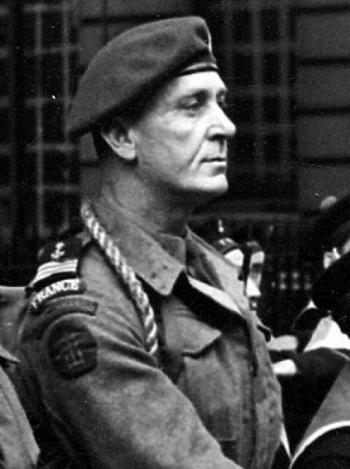

Alexander Stanier (1899-1995)
An officer in the British Army, he took part in both the First and Second World Wars. He particularly distinguished himself in 1940 and during the Normandy Landings in 1944.
On February 23, 1944, Stanier took command of the 231st Brigade (50th Infantry Division), made up of battalions from the Hampshire, Dorsetshire and Devonshire regiments. On June 6, 1944, these regiments landed on Gold Beach in the JIG sector (Asnelles-sur-Mer). Their objective was to seize the village of Arromanches and the surrounding area. The site was chosen by the Allies to provide an artificial harbour for the supply of troops the day after D-Day, and to carry out the Battle of Normandy.
After the war, General Stanier was hailed as a hero by the liberated people of Asnelles and Arromanches. Always present at D-Day ceremonies, he was one of the main instigators of the Arromanches Museum. In 1988, he was awarded the Légion d’honneur for his contribution to Franco-British relations.
William G. Tennant (1890-1963)
This British naval officer distinguished himself during the evacuation of Dunkirk in 1940. He enabled the re-embarkation of over 300,000 Allied soldiers encircled by the Germans. In 1944, he was in charge of the navy’s installation of the Mulberry ports. He also supervised the installation of the PLUTO system (Pipe-Line Under The Ocean). A pipeline installed on the bottom of the English Channel to supply troops with fuel from England.
